Monosodium glutamate, also known as MSG, is a sodium salt of the naturally-occurring non-essential amino acid, glutamic acid. This is a commonly-used food additive, and it acts as a flavor enhancer. It is also well-known for its trade name ‘Ajinomoto’. This food additive became infamous when it became a subject of health studies. A report from the Federation of American Societies for Experimental Biology (FASEB), which was compiled in 1995 on behalf of the United States Food and Drug Administration (FDA), concluded that this food item was safe for most people when it was ‘eaten at customary levels’. However, it also said that, based on certain reports, some people may have a condition that can lead to ‘MSG symptom complex’. This condition was said to cause the worsening of asthmatic symptoms.
Symptoms of Monosodium Glutamate
There are many signs that will help you to identify this condition. These range from being mild to severe, although they are usually mild, and true, severe Monosodium Glutamate sensitivity, which rivals peanut allergy, is rare.
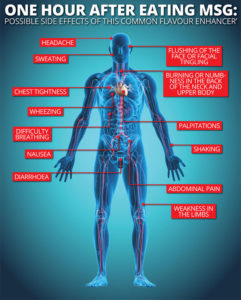
- Patients generally complain of a severe headache, which is throbbing in nature, leading to the feeling of the head contracting and expanding.
- Sometimes, people may also complain of dizziness and mental disorientation and confusion.
- Besides neurological signs, there may also be indications, like a burning sensation in the skin of the extremities, and even in the region of the chest, resembling a constant pinprick sensation.
- If the reaction signs begin to get very severe, then there may even be jaw tightness, which could lead to difficulty in opening the mouth, and even throat tightness. This throat tightness may transcend into upper chest tightness, which in turn could lead to breathing problems.
- This may be accompanied by chest pain and difficulty breathing with a crushing sensation in the chest.
- If the pain in the chest region aggravates, there may even be gastrointestinal disturbances, like nausea, vomiting, etc.
- Cutaneous changes include mild to moderate swelling of the face and related regions.

Difference Between Allergy and Intolerance
You need to understand that there is a difference between MSG allergy and intolerance symptoms. A food allergy is an immune system response, which occurs when the body mistakes an ingredient in food as being a harmful foreign body and lands up generating antibodies against it. Food intolerance, on the other hand, is a response by the digestive system, rather than the immune system. It occurs when some ingredient in a food irritates a person’s digestive system or when a person is unable to properly digest or breakdown the food due to the absence of an enzyme or some other factor that is present in that metabolic pathway. As is the case with most food allergies, there is no cure for this disease.
( Read about Garlic Allergy: Causes, Symptoms, and Remedies )
The only way of going about it is by staying clear of foods that contain this product. To aid people in this case, in 1993, the Federation of Drug Association proposed adding the phrase ‘contains glutamate’ to the common or usual names of certain protein hydrolysates, which contain such amounts of glutamate that it could prove to be of concern for certain individuals. The FDA considers labels such as ‘No MSG’ or ‘No Added Monosodium Glutamate’ to be misleading if the food item even contains ingredients that are sources of free glutamates, such as hydrolyzed protein. For people who do show true signs of this disease, the food additives disodium inosinate and disodium guanylate, which are nucleic acids, are usually preferable substitutes. In short, people who have this allergy may have to stay clear of eating out at Chinese restaurants way too often. Then again, that’s a very small price to pay for keeping the signs at bay!

What is MSG? Is it bad for you?
Monosodium glutamate (MSG) is a flavor enhancer commonly added to Chinese food, canned vegetables, soups, and processed meats. The Food and Drug Administration (FDA) has classified MSG as a food ingredient that’s “generally recognized as safe,” but its use remains controversial. For this reason, when MSG is added to food, the FDA requires that it be listed on the label.
MSG has been used as a food additive for decades. Over the years, the FDA has received many anecdotal reports of adverse reactions to foods containing MSG.
These reactions known as Monosodium glutamate symptom complex include:
- Headache
- Flushing
- Sweating
- Facial pressure or tightness
- Numbness, tingling or burning in the face, neck and other areas
- Rapid, fluttering heartbeats (heart palpitations)
- Chest pain
- Nausea
- Weakness
However, researchers have found no definitive evidence of a link between MSG and these symptoms. Researchers acknowledge, though, that a small percentage of people may have short-term reactions to MSG. Symptoms are usually mild and don’t require treatment. The only way to prevent a reaction is to avoid foods containing MSG.

Symptoms and diagnosis of Monosodium Glutamate
Those sensitive to Monosodium Glutamate may experience:
- headache
- hives
- runny nose or congestion
- mild chest pain
- flushing
- numbness or burning, especially in and around the mouth
- facial pressure or swelling
- sweating
- nausea
- digestive upset
- depression and mood swings
- fatigue

More serious symptoms may include:
- chest pain
- heart palpitations
- shortness of breath
- swelling in the throat
- anaphylaxis
Your doctor may ask if you’ve eaten any food containing Monosodium glutamate within the last two hours if they suspect you have an MSG allergy. A rapid heart rate, abnormal heart rhythm, or a reduction of airflow to the lungs may confirm an MSG allergy.